
Ripple Effect Thinking is recognizing that every action influences others in ways we may never fully see, and showing up in each interaction with intention. It challenges us to regularly consider the broader impact our behavior has on the people around us.
What is Ripple Effect Thinking?
CORE IDEA
You may control less than you’d like, but you influence more than you realize.
THE PROBLEM
Good Intentions Don’t Always Create Positive Impact
We tend to judge ourselves by our intentions. But other people experience us through our actions:
A manager who thinks they're being helpful may leave someone feeling criticized.
A colleague focused on efficiency may unintentionally make someone feel dismissed.
A leader trying to drive results may create an environment where people hesitate to speak up.
I call this Invisible Friction: the unintended impact we create for others through behaviors whose consequences we don't fully see.
Most of us aren't trying to make things harder for others. But that doesn't mean we aren't.
Ripple Effect Thinking is having a keen awareness that our words, action and decisions have far-reaching impact beyond what is immediately apparent.
THE SHIFT
From Siloed Thinking to Ripple Effect Thinking
We all get caught up in our own priorities, pressures and perspectives.
But when you focus only on what's directly in front of you, you slip into Siloed Thinking and can miss the broader impact of your choices.
SILOED THINKING
Make assumptions
Focus on the presenting problem
Jump to conclusions
Prioritize short-term outcomes
Focus on limitations
Ask “what’s in it for me?”
RIPPLE EFFECT THINKING
Seek the truth
Explore the root cause
Reserve judgment
Invest in long-term relationships
Look for potential
Ask “what’s in it for us?”
Ripple Effect Thinking challenges you to see those same moments through a different lens.
You’re still focused on the same goals, but you’re being more intentional about how you get there.
And when you make that shift, you create opportunities to replace Invisible Friction with human connection.
THE FIVE QUALITIES OF
RIPPLE EFFECT THINKING
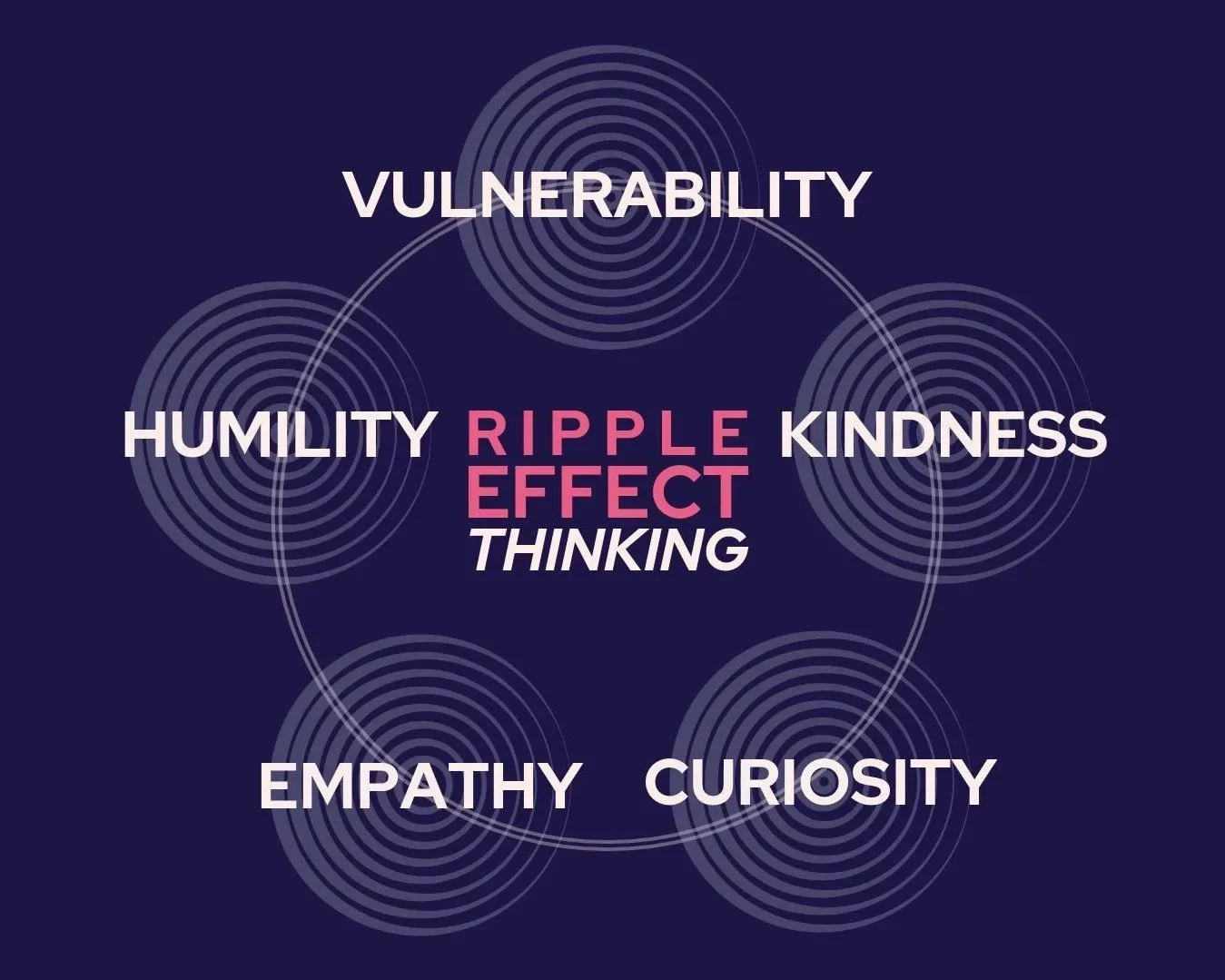
Ripple Effect Thinking requires us to practice and develop these five essential human qualities over and over again.
Vulnerability: Having the courage to show up authentically, acknowledge uncertainty, and admit when we're wrong.
Kindness: Choosing to treat people with care and consideration, especially when it's not the easiest choice.
Curiosity: Seeking understanding before making assumptions or jumping to conclusions.
Empathy: Considering how our actions and decisions might be experienced by someone else.
Humility: Recognizing that our perspective is incomplete and remaining open to learning from others.
These are choices available to all of us, in every meeting, every conversation, every interaction.
THE ACTION
Every Moment is an Opportunity to Start a Ripple
Every day is made up of hundreds of moments where we have the opportunity to influence someone else's experience.
The way you respond when someone makes a mistake can determine whether they feel safe taking responsibility or become afraid to speak up.
The way you invite a quieter voice into a conversation can uncover an idea that might otherwise go unheard.
The way you make a decision can either leave people feeling overlooked or help them understand how their work contributes to something bigger.
Individually, these moments may seem small. But their impact doesn't stop with the person directly involved.
When Ripple Effect Thinking becomes a shared mindset across an organization, those everyday interactions can compound into something much bigger: stronger trust, better collaboration, and teams that are more willing to contribute, support one another, and move forward together. Read the story behind Ripple Effect Thinking.
Bring Ripple Effect Thinking to Your Organization
Through engaging keynotes and interactive workshops, I help leaders and teams put Ripple Effect Thinking into practice to strengthen trust, connection, and collaboration.