
Home care and hospice teams stay connected to their purpose when they can recognize the difference their work makes in the lives of patients, families, and one another. Leaders can strengthen that connection by making everyday contributions visible, creating opportunities for meaningful recognition, and helping caregivers see the lasting impact of even the smallest moments.
This is especially important in professions where the work is deeply personal, emotionally demanding, and often performed without ever seeing its full impact.
I've come to understand this in a way I never expected.
What Can Hospice Teach Us About the Lasting Impact of Care?
My understanding of this changed profoundly when my older brother, Markham, was diagnosed with colorectal cancer four years ago.
Over the course of his treatment, he endured 42 chemotherapy treatments, two major surgeries, and countless other procedures.
Eventually, our family spent two weeks together at the Villa Marie Claire hospice in New Jersey.
During that time, there was a nurse named Yara who helped care for Markham.
Every time she came into his room, she'd look around at our family and ask, "Is there anything I can get anyone? Anything else I can do for you?"
Every time.
It was such a simple gesture, but it meant so much to us. She wasn't just caring for Markham. She was caring for all of us.
Yara was also in the room when my brother died.
Later that evening, as I was feeling the intense emotions of this experience, I asked her a question I'd been thinking about throughout those two weeks.
"How do you do this work?"
Her answer was beautiful and unexpected.
She talked about her faith. But she also shared a perspective I hadn't considered.
One of the most beautiful parts of her work, she explained, was getting to witness a family's love for one another.
While families are focused on their loved one who is dying, she has the opportunity to step back and see something they might not even recognize in the moment.
Just how much love is in the room.
I've thought about Yara and that conversation often.
Here I was, trying to understand how someone could find the strength to do such emotionally difficult work.
And Yara helped me see that alongside the grief and loss, she was experiencing something beautiful.
She was witnessing love.
And in the process, she was creating a ripple of her own.
I doubt Yara knew that her kindness and the simple question she asked every time she entered Markham's room would become something I'd remember long after he died.
But it did.
The most important moments aren't always the ones you'll remember. They're the ones someone else never forgets.
Why Is Staying Connected to Purpose So Important in Home Care and Hospice?
For home care and hospice professionals, purpose is often what draws them to the work in the first place.
They want to make a difference. They want to help people maintain their dignity, support families through difficult transitions, and bring comfort when it's needed most. Or they had a personal experience with home care or hospice themselves.
But the realities of caregiving can make that purpose difficult to see.
There are demanding schedules, documentation requirements, staffing challenges, difficult conversations, and the emotional weight of caring for people during vulnerable moments.
Over time, it's possible for the demands of the work to become more visible than the difference the work makes.
And there's another challenge that's easy to overlook:
Caregivers rarely get to see the full ripple effect of the care they provide.
A home care aide may never know how much peace of mind their visit gave a family member who lives hundreds of miles away.
A hospice nurse may never hear the story a family tells years later about the kindness they experienced during their loved one's final days.
A supervisor may never realize that a few words of encouragement helped a struggling employee find the confidence to keep going.
The impact is real, even when it's invisible.
Yara reminded me that purpose isn't always something we have to go looking for. Sometimes, it's right in front of us.
The opportunity is to recognize it.
How Do Small Moments Help Caregivers Reconnect With Their Purpose?
In my keynotes, I teach an approach called Ripple Effect Thinking, which begins with recognizing that our everyday actions and interactions can influence people in ways we may never fully see.
I often remind audiences:
"You may control less than you'd like, but you influence more than you realize."
For caregivers, that influence shows up in moments that can easily be overlooked.
The extra minute spent listening to a worried family member.
The reassuring tone used when entering someone's home for the first time.
The patience shown to a patient who is frightened or confused.
The encouragement offered to a colleague after a difficult shift.
Individually, these moments may seem small. Collectively, they shape how patients experience care, how families experience uncertainty, and how employees experience their workplace.
One way to understand this is through what I call the Three Ripples of Impact:
IMMEDIATE: The impact of someone in the moment
Example: A caregiver helps a patient feel safe and respected
INDIRECT: The impact that extends to others
Example: A family member feels reassured and shares that confidence with relatives
FAR-REACHING: The impact that lasts beyond the interaction
Example: Years later, a family still remembers how they were treated
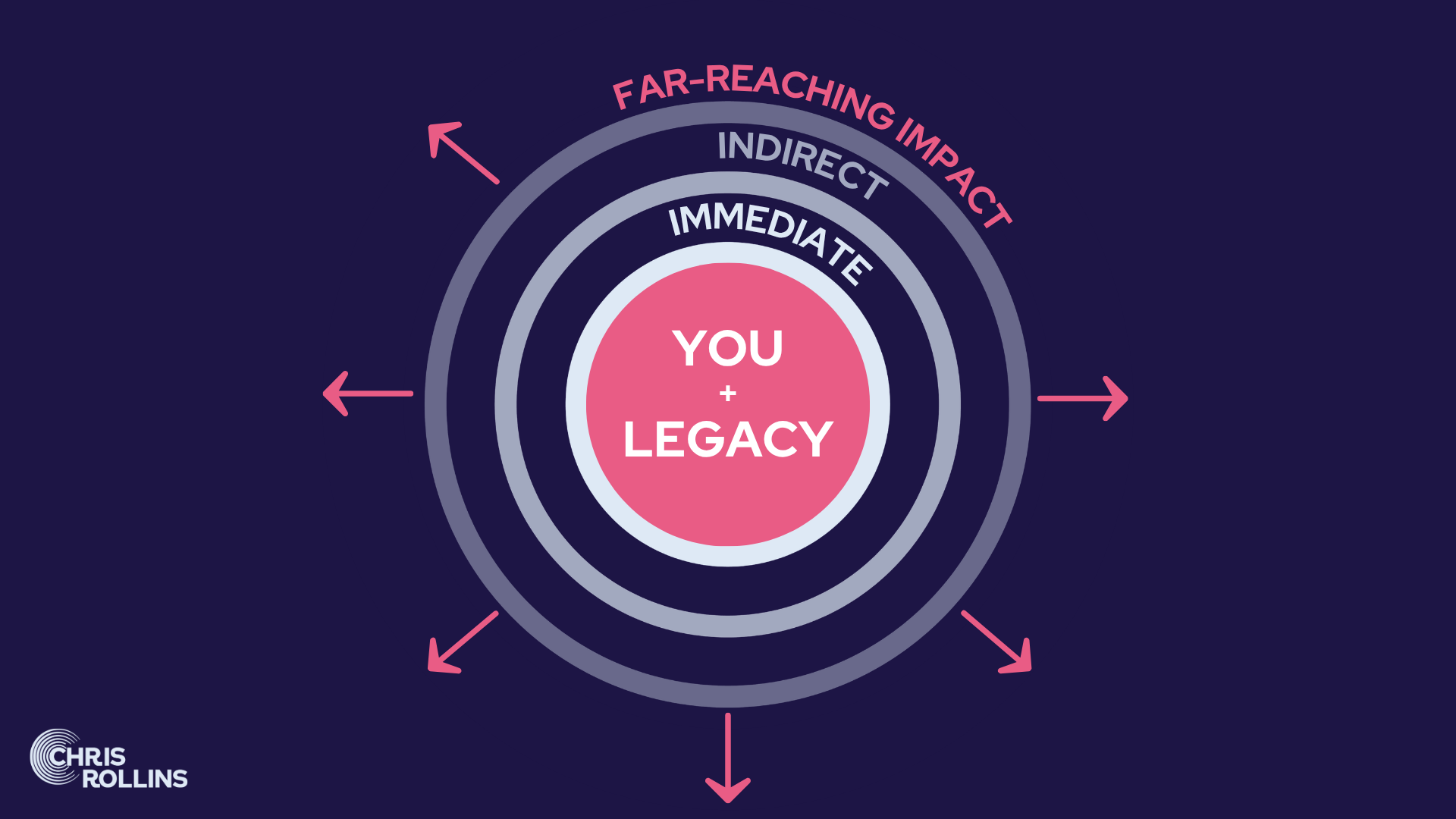
The Three Ripples of Impact with Legacy happening at the center, in each moment.
Most caregivers experience the immediate ripple.
They don't always get to see the indirect or far-reaching ripples.
Helping them recognize those possibilities is one way leaders can reconnect everyday responsibilities to a deeper sense of significance.
What Can Home Care and Hospice Leaders Do to Reinforce Purpose?
Staying connected to purpose shouldn't depend entirely on individual caregivers finding their own motivation.
Leaders have an important role in creating an environment where people can see the significance of their contributions.
Here are five practical ways to make that happen.
1. Make the invisible impact visible
Don't limit recognition to performance metrics, completed visits, or positive patient satisfaction scores.
Share specific stories about how an employee made a difference.
What did they do?
Who did it affect?
What happened as a result?
The more specific the story, the easier it becomes for other employees to recognize the impact of their own everyday actions.
2. Create opportunities for meaningful appreciation
Generic recognition has its place. But personal, specific appreciation often carries a different kind of weight.
Through my Start a Ripple Movement, we’ve shared over 5,000 postcards, traveling across more than 40 states and ten countries, inviting people to acknowledge someone who created a positive ripple in their lives.
The idea is simple: Tell someone what they did and why it mattered.
Imagine building that practice into your team's culture.
A caregiver recognizing another caregiver. A supervisor acknowledging an employee. A family sharing a moment they'll never forget.
These stories help make the impact of care visible.
3. Connect everyday tasks to the people they serve
Documentation, scheduling, coordination, and communication may not always feel like the most meaningful parts of caregiving.
But they contribute to the experience patients and families have.
Accurate documentation helps another caregiver understand a patient's needs.
Clear communication helps families feel informed.
Thoughtful scheduling helps preserve continuity and trust.
Leaders can help employees see how responsibilities that feel administrative are often connected to something deeply human.
4. Help caregivers feel seen, heard, and valued
Caregivers spend their days attending to the needs of others.
But who is attending to theirs?
A leader who takes time to listen, asks thoughtful questions, or acknowledges an employee's challenges creates a ripple of their own.
When caregivers experience the same dignity, empathy, and respect they're expected to extend to patients, leaders reinforce the culture of care from the inside out.
5. Make purpose part of everyday conversations
Purpose shouldn't be something organizations discuss only at annual conferences, employee appreciation events, or during onboarding.
It can be reinforced in the moments that already exist.
At the beginning of a team meeting, ask: "What's one moment from this week that reminded you why your work matters?"
During a one-on-one, ask: "Where have you felt like you've made the biggest difference lately?"
After a challenging experience, ask: "What did we do that helped someone feel supported?"
These questions don't eliminate the difficulties of caregiving. They create space to recognize the meaning that can otherwise get lost within them.
How Can Organizations Build a Lasting Culture of Purpose?
An inspirational event can remind caregivers why their work matters.
But sustaining that connection requires more than a single moment of inspiration.
It requires leaders to reinforce the message through their own behaviors.
That's why I believe the most important question for home care and hospice leaders isn't simply, "How do we remind our employees of our mission?"
It's also, "How do we help our employees experience that mission in the way we lead them?"
When leaders model vulnerability, kindness, curiosity, empathy and humility, they create conditions where connection becomes part of the everyday culture.
And that connection can ripple outward from leaders to caregivers, from caregivers to patients, and from patients to families.
The culture employees experience becomes part of the care others receive.
Of course, a sense of purpose doesn't eliminate the need for manageable workloads, adequate staffing, or organizational support. Caregivers need more than reminders that their work matters.
But when those foundations are supported, helping people recognize their impact can strengthen the connection between what they do every day and why they chose this work in the first place.
What Is the Legacy of Care?
Shortly after my brother died, I stood onstage in front of a room full of home care and hospice professionals.
It was one of the most meaningful speaking experiences of my career.
I wasn't simply sharing a leadership framework. I was speaking as someone whose family had just experienced the extraordinary significance of their work.
I wanted them to understand something that had become deeply personal to me.
There will be patients whose names they forget.
Families whose stories blur together.
Interactions that seem unremarkable by the end of a long day.
But somewhere, someone may remember that interaction for the rest of their life.
I think about Yara.
I think about the way she looked around the room every time she entered, making sure everyone had what they needed.
And I think about what she taught me that evening.
That even in the most difficult circumstances, there can be extraordinary moments of human connection.
Legacy isn't something you leave behind. It's something you cause every day.
And for home care and hospice professionals, that legacy is unfolding in moments they may never think twice about.
That's the Legacy of Care.
And it's why I believe helping caregivers stay connected to their purpose begins with helping them recognize how much their everyday moments matter.
Chris Rollins, the Ripple Effect Speaker, helps people see they influence more than they realize, for better or worse, and use that influence with intention. His Legacy of Care keynote helps home care, hospice, and healthcare professionals reconnect with the significance of their work and recognize the lasting impact of everyday human connection.
Explore the Legacy of Care keynote to bring this message to your next home care or hospice conference or leadership event.
